Why these two regions
We did not choose these two regions by chance. We chose them because, placed side by side, they complement each other almost perfectly.
One has capital, speed and global ambition. The other has opportunities, a strategic position and potential not yet fully realised. One is looking for where to invest for the long term; the other needs long-term investment.
One of the most dynamic and flexible markets in the world
In just a few decades, the states of the Gulf Cooperation Council (GCC) have become one of the world's most important economic and financial centres. What makes them unique is not only their wealth, but the way they use it: quickly, strategically and with an eye on future generations.
Capital for the future.
Gulf sovereign wealth funds manage assets estimated at around USD 5.2 trillion, and the market capitalisation of GCC stock exchanges reached about USD 4 trillion in mid-2026. Few regions in the world have such capacity to invest for the long term.
Speed of decision.
In the Gulf, a strategic decision can become a project in a few months, not a few years. Governments and major investors work with long-term visions and put them into practice quickly.
Flexibility and reinvention.
Free zones, rapid reforms, openness to foreign investors and a rare capacity to adapt. The Gulf states constantly update their rules to remain competitive and attractive.
Economic diversification.
Through major economic transformation programmes, the Gulf states are investing heavily beyond oil and gas: in technology, infrastructure, green energy, logistics, tourism, industry and food security. A growing share of these investments is directed abroad, towards trusted partners.
Resilience.
The Gulf has repeatedly shown that it can weather crises and recover quickly. Even after the shock of 2026, the International Monetary Fund expects a strong rebound for the GCC economies in 2027, as trade and energy production normalise.
In short: the Gulf has the capital, the speed and the ambition to build global partnerships. It is looking for sound opportunities and trusted partners.
Where the interests of every major global player meet
Few regions in the world concentrate so many strategic interests in one place. Central and Eastern Europe is at the same time the eastern frontier of the European Union and NATO, the gateway between Europe and Asia, the link between the Baltic, the Adriatic and the Black Sea, and one of the most dynamic economic areas on the continent.
All the major players meet here.
The European Union invests here through its cohesion and recovery funds. The United States is present strategically and economically, including through financing for regional infrastructure. Major European, American and Asian companies are moving production and service centres here. And Gulf capital is increasingly discovering the region. For each of these players, Central and Eastern Europe matters.
A large and growing market.
The thirteen states of the Three Seas Initiative bring together more than 120 million Europeans, over a quarter of the EU population, and an economy of more than USD 3 trillion. The EU member states in the region are growing more than twice as fast as the euro area, according to 2026 estimates.
Vast investment needs.
The region's infrastructure investment gap is estimated at up to EUR 1 trillion: energy, transport, digital networks, ports, logistics. It is one of the largest investment opportunities in Europe.
Strategic position.
The region sits on the new economic corridors between Europe, the Black Sea, the Caucasus and Asia. Energy security, the reconstruction of Ukraine and the relocation of supply chains closer to Europe place it at the centre of attention for decades to come.
People and skills.
A well-educated population, competitive costs, engineers, IT specialists and a strong industrial tradition.
In short: Central and Eastern Europe has the opportunities, the strategic position and the need for capital. An important part of Europe's future is being decided here.
Why together
Side by side, the two regions complement each other naturally:
| The Gulf brings | Central and Eastern Europe brings |
|---|---|
| long-term capital | investment opportunities |
| speed of decision | access to the European single market |
| experience in large-scale projects | industrial and technological skills |
| a need for diversification | a need for infrastructure and energy |
| an interest in food security | farmland and agri-food production |
| global ambition | a strategic position between Europe and Asia |
The result is not a simple transaction, but a partnership in which each side gains more together than alone. Storge's role is to make this meeting possible: to bring the right people to the same table and turn opportunity into joint investment.
A destination for investors from around the world
The two regions are not only partners for each other. Together, they form one of the most interesting investment areas for international capital. The Gulf offers access to capital, to global financial centres and to rapidly diversifying markets. Central and Eastern Europe offers access to the European single market, to strategic projects and to attractive returns.
Storge brings investors from Western Europe, North America, Asia and other parts of the world into these regions. We give them everything they need to invest with confidence: verified information, access to the right partners and decision-makers, and local support through our offices in both regions.
The markets we cover
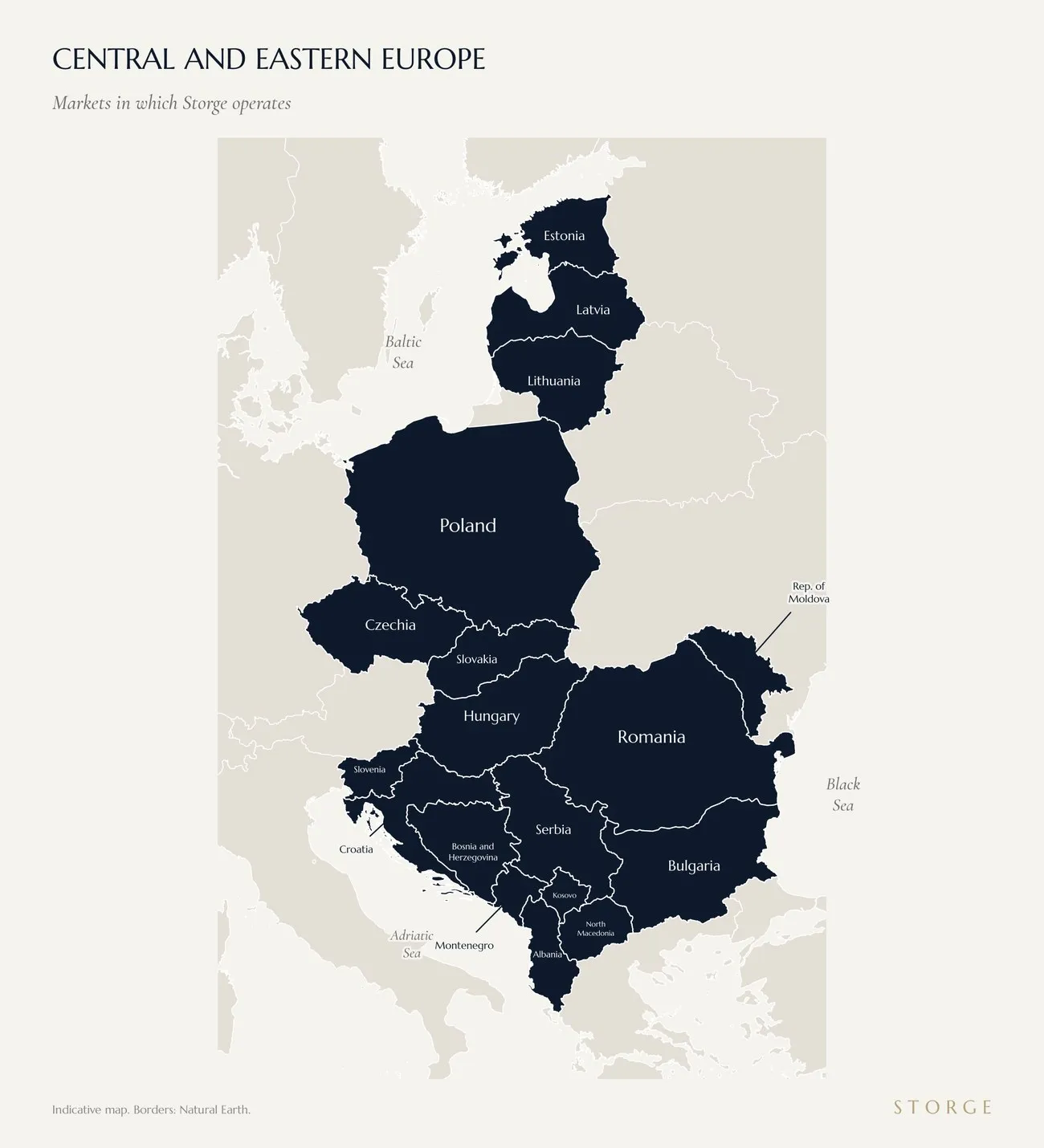
Central and Eastern Europe: Romania, Poland, Hungary, Czechia, Slovakia, Slovenia, Croatia, Bulgaria, the Republic of Moldova, Estonia, Latvia, Lithuania and the Western Balkans (Serbia, Bosnia and Herzegovina, Montenegro, North Macedonia, Albania, Kosovo).
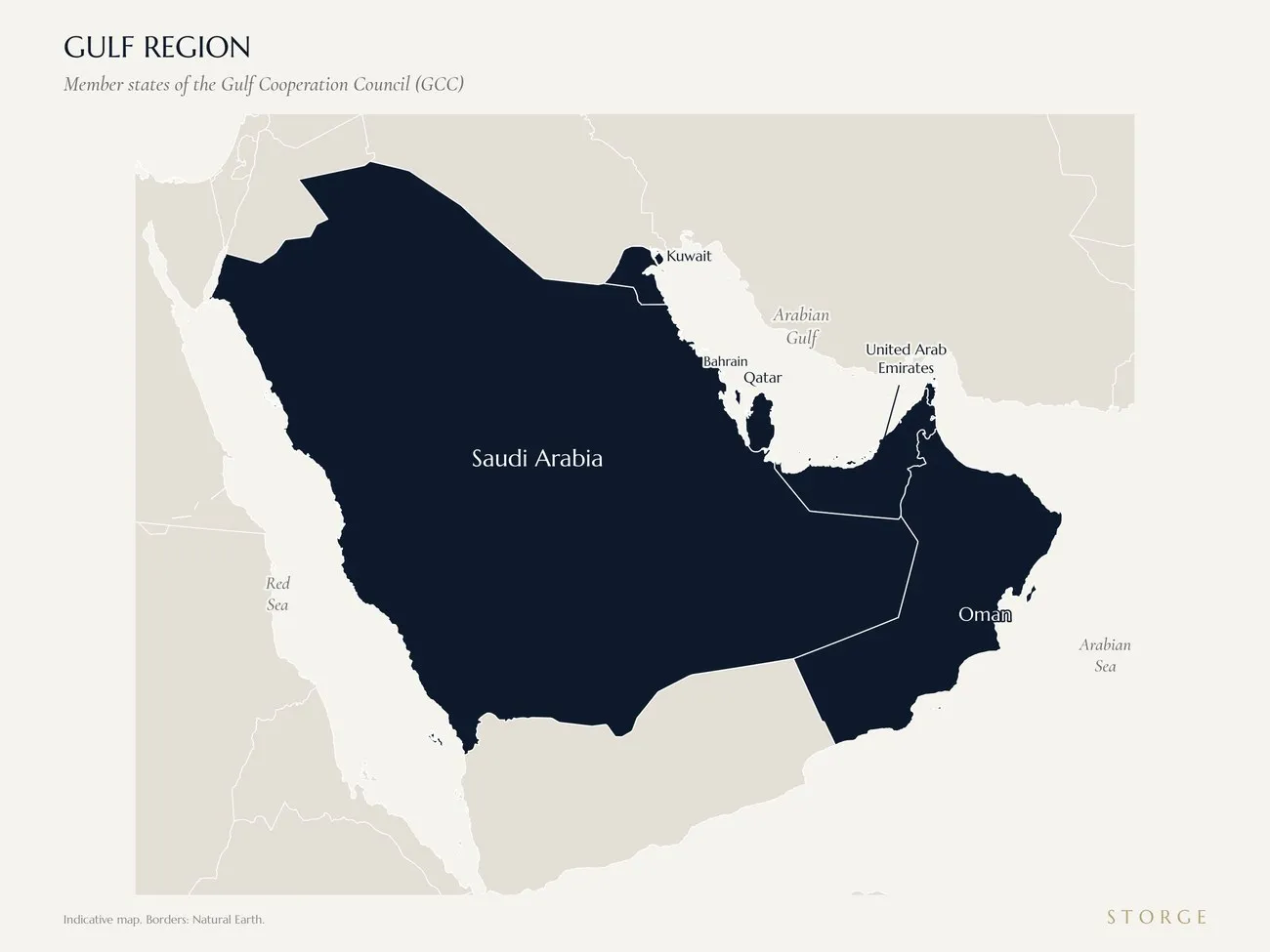
Gulf region: United Arab Emirates, Saudi Arabia, Qatar, Kuwait, Bahrain and Oman.
Key sectors
- Energy and the energy transition
- Infrastructure
- Agriculture and food security
- Logistics and ports
- Real estate
- Technology
- Industry
- Defence
One has the capital. The other has the opportunities. Together, they can build far more.
Schedule a conversation